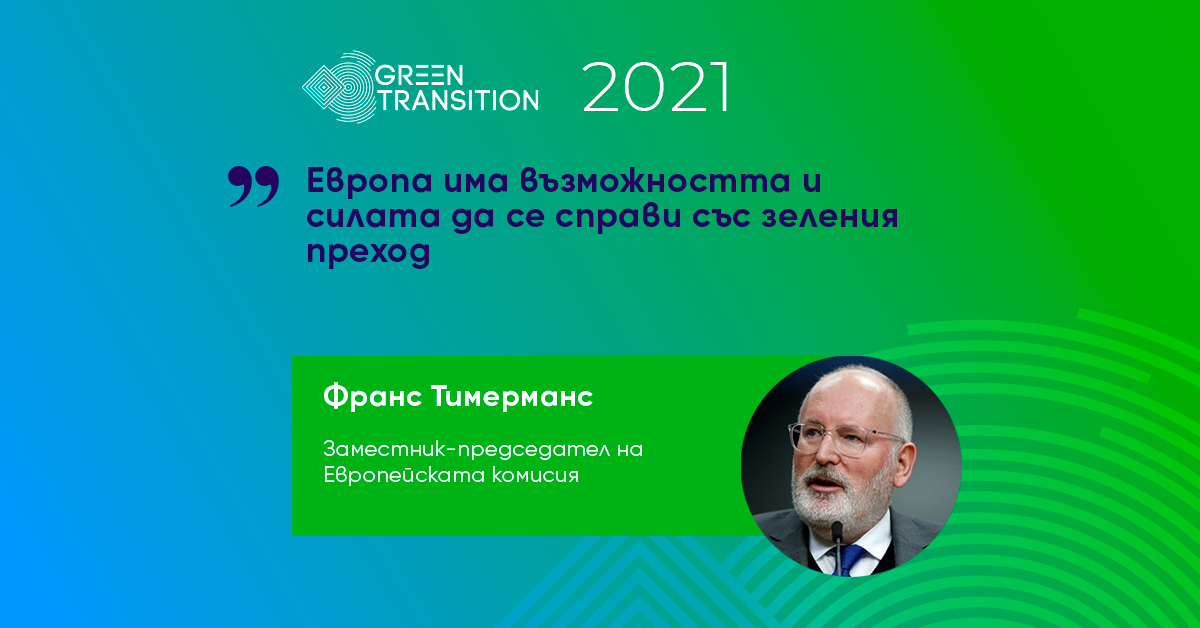
Frans Timmermans: Europe has the opportunity and the power to handle the green transition
Francis Cornelis Gerardus Maria Timmermans is a Dutch politician and diplomat. He has served as First Vice-President of the European Commission since 2014 and in the current Commission as Executive Vice-President of the European Commission for the European Green Pact and as European Commissioner for Climate Action since 2019. Prior to that, he was Jean-Claude Juncker's First Vice-President and European Commissioner for Better Regulation, Inter-institutional Relations, the Rule of Law and the Charter of Fundamental Rights from 2014 to 2019.
Timmermans previously served in Dutch government bodies and was a member of the Labour Party's House of Representatives (1998-2007; 2010-2012). He also served as Under Secretary of State for Foreign and Commonwealth Affairs with responsibility for European Affairs (2007-2010) and as Foreign Secretary (2012-2014).
On 15 October, Frans Timmermans visited Bulgaria for the international forum of Dir.bg and 3E-news "Green Transition - Challenges and Solutions for Bulgaria". During the conference the Vice President of the European Commission talked with the caretaker Prime Minister Stefan Yanev, who presented to him our Recovery Plan just a day after the document was adopted in the Council of Ministers.
https://youtu.be/4d0nBsduBtMMr Timmermans, will the energy crisis in Europe change the EU's climate neutrality goals? Recently you said it would speed up the Green Transition" - what are your arguments ?
I certainly hope so, because that is the only way to make sure that we are not constantly affected by market movements. Now the prices are very high. By meeting the Green Transition targets, Europe will reduce its dependence on natural gas prices. For this to happen, we need to have renewable energy that is cheap in the long run and can be installed quickly once the investment is made.
Is this going to be the preferred instrument for solving not only climate but also energy and economic challenges?
If EU leaders draw the right conclusions from this energy crisis. And not to think "oh, we are in crisis, let's slow down the processes". That would be the worst possible reaction to the current situation, and it would be better to speed up these processes.
The green transition is not only a policy, but also a way of thinking. Do you manage to find support among EU citizens for the policies you pursue? What motivates you in this direction?
You know that most Europeans are worried about the climate crisis. They understand that we are existentially challenged by these changes. In Bulgaria there is still a lot to be done on this issue, but most European citizens are extremely concerned and because of this fact this is a major topic in the EU. Even during the coronavirus crisis, the climate crisis remained at the top of the agenda for most people. But I understand that if you're in a situation of not knowing if you're going to make ends meet, then the end of the world isn't exactly your first concern. But when we analyse the challenges that we all know about, we understand that we have to change the situation. And we need to change it in a fair and transparent way so that no one is left out.
And this is the way?
Yes, I think it is the only way. And we need to prove to people that they will not be left alone.
How can this proof happen?
You know, politics always aims at one main thing. Whether it is left, right or centrist. This is about redistribution, this is politics. We need to make sure that society develops in an equitable way, that there are no gaps between different groups within it and that we help people who cannot help themselves. And this is hugely important in times of huge transition, as we are experiencing now with the transition from carbon-intensive to climate-neutral fuels. The main problem is how to organise things in such a way as to prove to people that no one will be left behind. And how are we going to create new opportunities because there are 2 million new jobs that are expected in the green economy. But we also need to make sure that people get those jobs, and in the right regions.
What are your expectations from COP 21 in Glasgow, which starts at the end of the month? Can we think of a follow-up to the Paris Agreement?
Since the Paris Agreement, we have had very worrying reports from the international committee on climate change. The latest analyses show that we are very far from the goal we should be pursuing in order to prevent catastrophe. And what we need to do now is to take measures that will allow us to fit within the Paris Agreement. And that is to stay well below the 2 degrees Celsius warming levels of pre-industrial levels. And so we have the opportunity to stay under 1.5 degrees. To do this, we need to radically change our economy.
What should happen in Glasgow? Countries need to be more ambitious about reducing greenhouse gases and developed countries need to invest more in developing countries. So these countries will understand that solidarity is something that actually works.
Thirdly, we need to come to an agreement on defining the "rules of the game" - that we all globally play by the same rules so that information can be collated. Then we will all know that we are moving in the right direction.
These are severe problems. Do you think you can come to an agreement?
First of all, I have become much more optimistic in the last few months. The reason for this is that more and more countries are taking more ambitious positions on the issue. This is a development in a good direction. Secondly, we have to be honest - we will not be able to fill the gap completely. We should aim to keep this gap as small as possible.
In terms of both funding and ambition, we are looking ahead. And will it be enough? Let's wait and see. If not enough, we will correct this after the Glasgow meeting. The important thing is to keep pushing, because there is positive momentum at the moment, and to keep going on this path.
"Not to turn our backs on anyone, but also to control the green transition process." A similar thought of yours, I read recently, if I understood correctly. Does Europe have the strength to cope with such a challenge?
We have the capacity and the strength to cope. But it has to start with the realisation that if we do nothing, the problem will become much bigger. Because there is a fundamental misunderstanding among some people that if nothing is done, everything will remain as it is. Not so. The cost of doing nothing is significantly higher compared to action. And the cost of not doing so is particularly acute among the poor sections of our society who suffer the most. People who have nowhere else to go.
So if you have a lot of natural fires, floods, or the crop produced is none, then if you are poor you have nowhere to go. If you are rich there is always a place to move to.
It is the Green Deal that is particularly relevant to people who are in less enviable positions, not the powerful people in society. That is why we need to make sure that the Green Deal is also a social deal. To make sure that no one gets left behind, and so that we distribute our efforts in such a way that people whose jobs will not exist in the future will gain new knowledge and skills. And they will be for sectors that will continue to have them.
This is also relevant for the demographic situation in Europe. Nobody wants to be unemployed in the future and that is why we must work to strengthen our economy.
This is the goal of the Just Transition Fund and the Social Climate Fund.
Exactly. We are mobilising billions of euros so that member governments can redistribute this funding to the people who will need it most. So through the climate social fund we will avoid energy poverty during the transition. And through the Just Transition Fund, we will help the 30 coal regions across the EU to overcome their coal dependence and create a new and strong economy. This is exactly what we do.
What mechanisms does Europe have to counter the global energy crisis that is engulfing the world? Is it possible to calm energy prices by influencing the Emissions Trading Scheme market or through tax policies, for example?
Energy is a sector with great political influence. But energy is also heavily taxed everywhere. So some of the levies could be temporarily reduced, and that would lower people's energy bills. There may also be compensation for people because of high bills. You can defer payments for a certain period of time. And other issues may be considered.
For example, one could analyze the possibility of collectivizing energy if that would work. We have different policy tools. But we should be aware that the current crisis is only temporary. It is not long-term because energy prices will go down again in the spring. It all depends on how severe the winter will be and how we get through it in the next few months.
And is it possible to have an impact through the emissions trading scheme?
Let's put things another way. The market price of natural gas is eight times more influential on the price of electricity than the emissions trading scheme. Because of this, the ETS actually has little impact on electricity prices. And if we start to consider options for changes to the emissions trading system, the outcome of that will also be marginal. It is far better to look at the market situation in the energy markets.
I give you an example: over the last year, the price differences per tonne of emission allowances have risen from EUR 30 per tonne to approximately EUR 60 per tonne. This has resulted in additional revenue for member states of almost €11 billion - that's an extra income in one year - compared to a year earlier. These funds can be used to help people, to support them. That is why we have the emissions trading scheme. And governments need to show people what they are doing with their money. It is the citizens' money and can be used for their welfare.
During the conference "Green Transition - Challenges and Solutions for Bulgaria" you mentioned another source of electricity, besides renewable energy. I am talking about nuclear power. Do you think this kind of energy can help the energy transition?
Nuclear power has huge advantages because it has no carbon emissions. But there are a few drawbacks - it's too expensive and it takes a long time before you get electricity from a NPP project. I don't know of even one case of a nuclear power plant project that was completed on time. Construction always takes longer, and the cost always doubles, even triples, regardless of the construction location - whether we are talking about Finland or France. So I have nothing against the development of nuclear power, it has huge advantages because of its zero emissions. But watch out, because it's very expensive and can take a long time before you get electricity from a NPP.